
Emmet Parole and Probation Compared
Parole and probation can both place a person under rules in the community, but they begin in different ways. The Michigan Parole Board grants parole after a person has served time in an MDOC prison. The person has left prison yet remains under MDOC jurisdiction. Probation comes from the sentencing court. It may be part of a felony sentence supervised by MDOC Field Operations Administration, or a misdemeanor matter handled through the local court. That local distinction matters because an Emmet County misdemeanor probation case may not appear in the state OTIS search.
The legal source also differs. A parole status should be checked against MDOC’s Offender Tracking Information System, known as OTIS. A probation search can begin there, but a 90th District Court register may be needed for a misdemeanor. The court retains authority over probation even when MDOC performs day-to-day supervision. Neither status is the same as final discharge.
| Point | Parole | Probation |
|---|---|---|
| How it begins | Michigan Parole Board action after prison | Order of the sentencing court |
| Custody meaning | Person has left prison under conditions | May follow jail or be imposed without prison |
| Best public check | OTIS Parolees or All status | OTIS plus the sentencing court record |
| Local correction path | Emmet County MDOC field office | Field office or sentencing court, based on case type |
| End point | MDOC discharge after supervision or sentence end | Court or MDOC supervision discharge |
- Parole
- Conditional release from prison while MDOC jurisdiction continues.
- Probation
- Court-ordered community supervision instead of, or after, confinement.
- Discharge
- The end of supervision or MDOC jurisdiction for the sentence.
- Absconder
- A supervised person who failed to report and is no longer under active supervisory control.
Verify Emmet County Supervision
OTIS offender search is the primary public tool for Michigan parole, many felony-probation cases, discharge, and absconder categories. Search by MDOC Offender Number when possible. A name search can be narrowed by first name, sex, race, or age. Choose “All” when the expected state is uncertain. More focused choices include Parolees, Probationers, Discharged, Parole Absconders, and Probation Absconders.
Identity must be checked before relying on a match. Compare date of birth, location, offender number, conviction, and sentence details. Then read the status and the page’s data-as-of time. OTIS can also show the Parole Board Jurisdiction Date, Maximum Date, and Date Paroled. The jurisdiction date is an eligibility point, not proof of physical release. “Date Paroled” is the stronger state-prison exit field.
- Open OTIS and search by MDOC number, or use the person’s full name with added identity fields.
- Select All if the status is unknown. Use a parole, probation, discharged, or absconder filter only when the expected category is known.
- Open the likely profile and compare identity, conviction, sentence, location, status, and the data-as-of timestamp.
- For probation, locate the sentencing court. Check the 90th District Court search for a misdemeanor or the 57th Circuit record for a felony.
- Contact the Emmet County field office if the public supervision entry appears stale or needs office-level confirmation.
OTIS is not a full archive of all jail cases. A person released from the Emmet County Correctional Facility after a short local sentence may never enter MDOC supervision. In that case, use the Sheriff release record and the court case. The full county custody path appears on the Emmet County released-inmate search.
For a view of the state system, the MDOC parole and probation overview shows how Field Operations Administration divides its work. The official page pictured below helps distinguish MDOC supervision from a county jail release record.
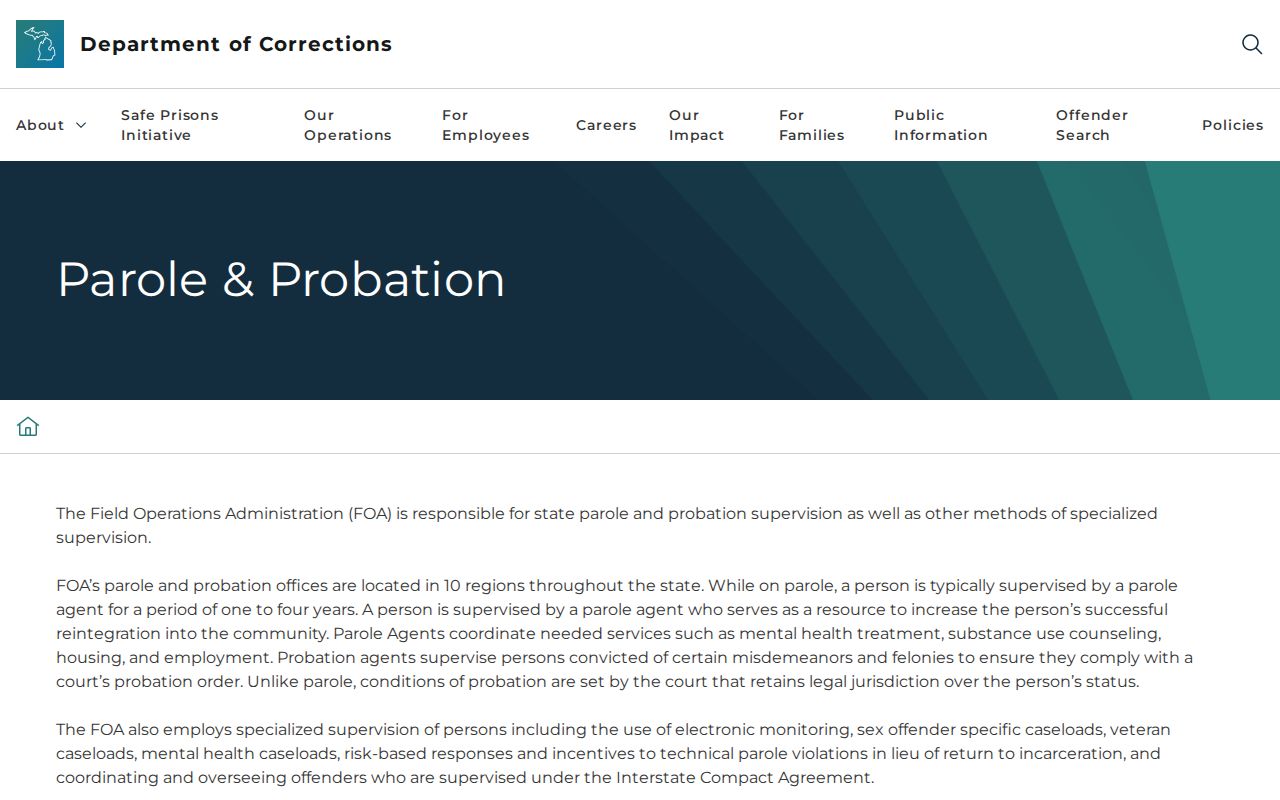
The state page supplies policy and agency context, while OTIS and the Petoskey office provide the person-specific verification route.
Note: A missing OTIS entry does not prove that supervision never existed or that a local court case has ended.
Emmet Supervision Office Details
The named local correction point is the Emmet County Parole/Probation Office. It is part of MDOC Region 2 and sits in the same Division Street government complex as several county justice offices. Contact the office when OTIS lists local supervision but the reporting location, supervision state, or absconder information needs a current check.
Emmet County Parole/Probation Office200 Division Street, Suite G26
Petoskey, MI 49770
231-348-1749
Region 2 also has an operations office at 301 W. Upton Avenue, Reed City, MI 49677, phone 231-832-6179. The Petoskey office is the more direct route for an Emmet County case. It can address supervision data and field-office placement, but it is not the source for correcting a court judgment. That source split prevents one office from being asked to alter another agency’s record.
Correct Emmet Supervision Records
Michigan divides error correction by the origin of the information. If an OTIS error came from a judgment, conviction, sentence, or other court record, take the issue to the sentencing court. The court controls its own filed order. If the problem concerns current supervision, office assignment, or an absconder classification, contact the supervising MDOC office instead.
Keep the exact OTIS label and access date. Dynamic records change. A screenshot or saved result can help the office identify what appeared publicly, but it does not replace the agency’s live file. For Emmet County felony cases, the 57th Circuit Court may hold the controlling judgment. The 90th District Court handles misdemeanors and preliminary felony matters. A transfer or bindover can make both registers relevant at different points.
Emmet Parole Probation Absconders
OTIS keeps separate filters for parole absconders and probation absconders. Michigan uses the code ABSCOND1 for a parole absconder and ABSCOND2 for a probation absconder. Absconding means the person failed to report and supervisory control was lost. It is not a normal end to parole or probation. It also must not be described as a fresh community release.
The responsibility differs. MDOC actively seeks a parole absconder. For a probation absconder, OTIS says apprehension responsibility rests with the sentencing county. The public result may show the status, but questions about an active warrant, surrender, or case action should go to the office or court that controls the matter. Do not assume the absence of an arrest entry means the absconder label is no longer valid.
Michigan VINE has a different purpose. It reports custody changes such as release or transfer for participating facilities. It does not replace OTIS as the public supervision-status source. A person can be out of jail and still appear as a parolee, probationer, or absconder.
Note: Contact the listed office before treating an older absconder result as a current statement of physical location.
Emmet Reentry Program Navigation
The Emmet County Office of Community Corrections coordinates community-based programs with courts, probation, and parole. Its stated mission includes people reentering the county from jail or prison. The office is located at 200 Division Street, Suite G24, Petoskey, MI 49770, and can be reached at 231-348-0680 during posted weekday office hours.
This office is a program and navigation point. It is not a person locator, custody database, parole decision maker, or substitute for an officer. A reader seeking to confirm supervision should still use OTIS and the Emmet County Parole/Probation Office. Community Corrections becomes relevant when the need concerns local programs linked with the courts and supervision system.
Emmet Parole Board Outcomes
The Michigan Parole Board is the sole paroling authority for felony offenders committed to MDOC. Routine cases are generally decided by three-member panels. Eligibility does not create a right to leave prison. A grant remains subject to notice, possible appeal, release planning, continued conduct, and processing. A denial keeps the person incarcerated for later review. A deferred result postpones review, and a suspended or rescinded grant does not authorize current release.
The state’s public-hearing page is narrow. It lists Lifer Law, pardon, and commutation hearings, not routine parole interviews or parole-violation cases. No comprehensive public statewide database of Board decision documents was found. OTIS can show status and Date Paroled, but not the full reasons. For a releasable result, contact the Board, the Parole Release Unit, or request the order through MDOC FOIA.
The official parole consideration process explains the decision stages. “Paroled” reflects physical departure when supported by Date Paroled. “Discharged” means MDOC jurisdiction ended and may follow a period of community supervision. Those terms should not be collapsed into one release date.
Emmet Supervision Discharge Records
Supervision ends through a formal discharge, not merely because a person stops appearing at an office or reaches an expected date. OTIS uses DISCHRG when MDOC jurisdiction for the sentence has ended. MDOC says discharge can follow successful parole or probation, expiration at the maximum date, or death before completion. That last possibility is why a bare discharged state cannot always prove a living community release.
Public OTIS display is limited. A discharged record generally remains visible for three years after the latest discharge, unless it is removed sooner by set-aside, expungement, or another nondisclosure rule. The display limit is not the MDOC retention schedule. For durable proof, request the discharge record from MDOC or obtain the court’s order. A final discharge also differs from a parole grant, which begins conditional supervision rather than ending state jurisdiction.
Public Record Search
Sponsored Results