
Emmet County Release Date Types
There is no single projected-date field that applies to everyone connected with Emmet County. The Emmet County Correctional Facility holds both sentenced and unsentenced adults. An unsentenced person may leave after bond, dismissal, a court order, or transfer, so the next event can depend on a hearing or on clearing another hold. A county sentence may have a computed end date, jail credit, or lawful good-conduct reduction. A state prison sentence uses a different MDOC framework.
Michigan’s Offender Tracking Information System, known as OTIS, does not label a central field “Projected Release Date.” It shows Parole Board Jurisdiction Date, Maximum Date, and Date Paroled. Those three fields answer different questions. Calling the first one a booked release appointment would overstate the record.
| Date or event | Meaning | Best source |
|---|---|---|
| Next court event | May affect a pretrial detainee, but is not a promised release. | 90th District or 57th Circuit record |
| County sentence end | Calculated from the judgment, jail credit, sentence structure, and applicable jail rules. | Emmet jail and sentencing court |
| Parole Board Jurisdiction Date | Earliest release date when the Board gains authority to consider parole. | OTIS |
| Maximum Date | Potential last day under the controlling state sentence, subject to lawful calculation. | OTIS and MDOC record |
| Date Paroled | The day the person actually left prison on parole. | OTIS and MDOC release record |
A scheduled or eligible date is not an actual release. Confirm physical departure through the jail movement record or OTIS Date Paroled.
Lookup Emmet County Release Dates
Start with the system that holds the person. A jail-only case may never appear in OTIS, and a state prisoner’s long-term release history will not be complete in an Emmet County jail record. When identity is uncertain, use the booking number or MDOC number and reconcile name, birth date, court, and sentence before relying on a result.
- Identify whether the person is in the Emmet County jail, MDOC prison custody, federal custody, or another receiving facility.
- For an Emmet jail case, review the correct MiCOURT register for the judgment, bond, jail credit, amended order, and warrants.
- Call the Emmet County Correctional Facility at 231-347-2032 for a person-specific current calculation or unclear movement.
- For an MDOC case, search OTIS by offender number when possible and open every relevant sentence.
- Read Parole Board Jurisdiction Date, Maximum Date, and Date Paroled separately. Save the data-as-of time.
- Use Michigan VINE for a near-current custody alert, then confirm the event with the custodian’s record.
- Request the Sheriff or MDOC release record when a durable historical date is needed.
The Emmet County released inmate lookup supplies the full records-and-court chain for a person who has already left custody. This date page focuses on the narrower question of when release may occur and which public field proves it happened.
Emmet Pretrial Release Dates
An unsentenced Emmet County detainee often has no fixed release date. The next court hearing can address bond, probable cause, plea, dismissal, or another order, but the hearing date itself is not a scheduled exit. The 90th District Court generally handles misdemeanors and felony preliminary matters. A felony moves to the 57th Circuit Court after bindover for the later judgment and sentence.
MiCOURT can show bond entries, a dismissal, plea or verdict, judgment, jail credit, time served, probation, amended sentence, warrants, and violation events. Those entries explain legal authority. They may not show when jail staff completed physical release processing. A bond transaction can be valid while another hold remains, and a dismissal in one case may not resolve a warrant in another.
For a pretrial or short county case, reconcile the court register with Michigan VINE and the Sheriff movement record. The court controls its order, while the jail controls its physical custody log. Ask the Sheriff for the existing booking sheet, release or movement entry, and release-authorizing reference tied to the correct booking number. That chain avoids manufacturing a projected date where no sentence calculation exists.
Question: Is the next Emmet court date the inmate’s release date? Not by itself. It is a scheduled legal event. Only a resulting order plus completed jail processing can support physical departure.
MDOC Dates for Emmet Releases
OTIS covers people currently or recently under Michigan prison, parole, or probation jurisdiction. Search fields include last and first name, offender number, sex, race, age, status, and marks, scars, or tattoos. Status filters include prisoners, parolees, probationers, discharged people, and parole or probation absconders. The system is not an archive of every Emmet County jail booking.
The Parole Board Jurisdiction Date is MDOC’s earliest release date, often shortened to ERD. It is when the Board first has authority to consider parole. Maximum Date is the potential outer custody date on the controlling sentence. Date Paroled is the historical day of prison departure. A state profile may also show sentence entries, conviction information, location, status, and a data-as-of timestamp.
- Eligibility
- The point at which a decision-maker may consider release.
- Parole
- Conditional community supervision after the person leaves prison.
- Maximum date
- The potential outside boundary of confinement on the controlling sentence.
- Actual release
- The completed physical departure recorded by the custodian.
Note: OTIS displays discharged people for three years after the latest discharge, unless set-aside or nondisclosure rules remove the public entry sooner.
Michigan Truth-in-Sentencing Dates
Michigan’s modern truth-in-sentencing rule is not an “85 percent” shortcut. MDOC states that people with covered offenses must serve the full court-imposed minimum in prison before parole consideration. The rule applies to specified assaultive crimes committed on or after December 15, 1998, and other covered crimes committed on or after December 15, 2000. MCL 791.233b governs secure service of the minimum.
For a covered sentence, ordinary good time does not reduce the judicial minimum. Class I misconduct days are tracked as disciplinary time for Board review, but they are not a simple number that can be subtracted from the minimum. Older offenses may fall under good-time or disciplinary-credit provisions in MCL 800.33 and MCL 800.34. The offense date and governing sentence decide which framework applies.
The MDOC truth-in-sentencing explanation presents the official state rule.
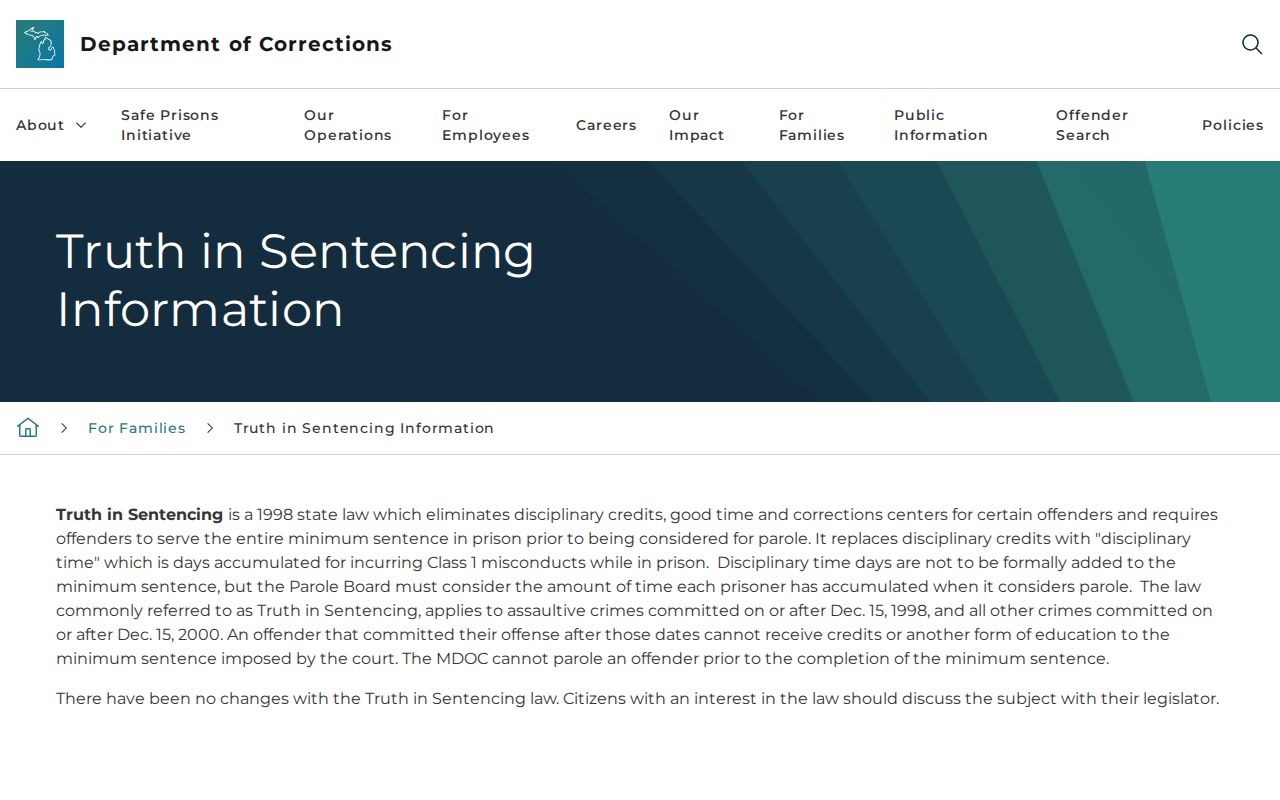
This state page supports full service of the covered minimum before parole review, not a universal percentage calculation.
Emmet County Parole Eligibility
Parole remains discretionary under MCL 791.233. Discretionary means the Board may grant or deny release after weighing the governing factors; eligibility creates no right to leave. The Michigan Parole Board considers guidelines, the offense, prior history, prison conduct, program work, risk instruments, interviews, and victim material. A favorable decision then moves through release planning.
MDOC states that at least 28 days separate a release decision from physical departure. A prosecutor or victim appeal, new adverse information, misconduct, a missing placement plan, or a suspended grant can delay or stop release. For that reason, a Board grant and a Date Paroled should never be merged into one event. The grant authorizes continued processing. Date Paroled records that the person left.
Question: Can a family member use the earliest release date as a pickup time? No. It is an eligibility date, not a facility appointment. Confirm the actual plan with the responsible correctional office and follow official instructions.
Why Emmet Release Dates Change
Release calculations can change when the legal or custody record changes. Some changes come from the court. Others come from sentence administration or the Parole Board. A current screenshot is useful evidence of what OTIS showed on that day, but it is not immutable. Save the data-as-of timestamp and recheck close to the expected event.
| Change | Possible effect | Where to verify |
|---|---|---|
| Amended judgment or resentencing | May alter the minimum, maximum, or jail credit. | Sentencing court and MDOC |
| Consecutive sentence | Can move eligibility and maximum dates later. | Court judgment and OTIS sentence entries |
| Jail-credit correction | May change county or state time calculations. | Court order and custodian |
| Misconduct or older credits | Can affect a credit-eligible or Board-reviewed date. | MDOC record |
| Parole grant suspended | Stops the planned release while review continues. | Parole Board or Release Unit |
| Detainer or other hold | May cause transfer instead of community release. | Custodian movement record |
Emmet County Jail Good Time
County-jail calculations use a separate Michigan rule. MCL 51.282 provides a good-conduct framework commonly described as one day of reduction for each six days actually served when a person faithfully follows jail rules, subject to forfeiture and exceptions. The Sheriff administers jail credits under this framework. MDOC truth-in-sentencing does not calculate an Emmet misdemeanor release.
Court-awarded jail credit, mandatory terms, concurrent or consecutive sentences, misconduct, and amended orders can all affect the result. Concurrent sentences run at the same time, while consecutive sentences run one after another. Work-pass or intermittent confinement under MCL 801.251 permits a structured temporary absence and does not turn each departure into final release.
No official Emmet source establishes an automatic early-Friday practice for a sentence ending on a weekend. There is also no published routine release hour. Ask the jail to confirm the particular calculation and instructions rather than importing a practice from another county.
The judgment remains central. “Time served” describes a court disposition, while the Sheriff movement entry fixes the actual exit. A person may also leave the Bay Street facility through transfer to MDOC or another custodian. That movement ends Emmet County physical custody but is not a community release, so it should not be reported as an early release produced by good time.
Confirm Emmet County Actual Release
For the county jail, the strongest physical proof is the Sheriff’s release or movement timestamp tied to the correct booking. Michigan VINE can provide a near-current alert, and the court record explains whether bond, dismissal, time served, probation, or another order supplied the legal basis. A bond payment alone is not proof of departure because another hold or processing step may remain.
For state prison, use Date Paroled or a releasable MDOC movement record. A PAROLE status means the person left prison but remains under conditional supervision. DISCHRG means MDOC jurisdiction ended, which can occur after supervision, at a maximum, or for another defined reason. For a federal prisoner, use the BOP locator. A past release date or Released location ends BOP custody but does not rule out another jurisdiction.
Never convert an eligibility date, court event, bond receipt, or transfer into an actual community release without a custody-exit record.
The Emmet County VINELink release check can monitor a near-current event. Request the agency record when the exact historical time and movement type must be preserved.
Note: A projected date is a current calculation; the custodian’s completed movement entry is the historical release record.
Public Record Search
Sponsored Results